
One Curation
Concept2Commission
Pro-Design +build.
Pro-Design
Architectural Acoustic Strategies
Measurements Before & After
Acoustic Design Parameters
Acoustic Products Material Selection
AV Solutions
Stage - Lighting + Drapery
+build.
Live Demos
3D Views & VR Walkthrough in-house Team
Project Tracking System
Seamless Handover
Completion Acoustic Test Report
Yearly Maintenance Programme
Pro-Design
Architectural Acoustic Strategies
Room Geometry | Curved Surfaces | Volume Adjustment | Analyzing Vibration & Impact Sound Insulation (IIC)
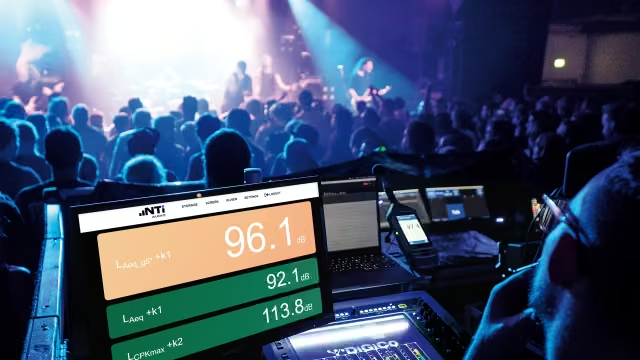
Measurements Before & After
Site Survey & Sound Mapping | Reverberation Time (RT60) | Music-Focused Speech-Focused | Initial-Time Delay Gap (ITDG), Clarity Index (C80) | Ambient/Background Noise Level & Airborne Sound Insulation (STC/RW)
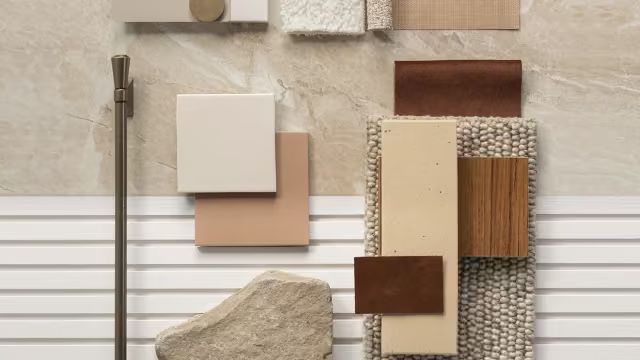
Acoustic Meets Design (Material Selection)
The process of designing a space that requires performance as well, is always a challenge as AESTHETIC DESIGN & ACOUSTIC PERFORMANCE has to be balanced. Our specialized team comprises of In House Design Team to curate DESIGN & ACOUSTICS to come together.
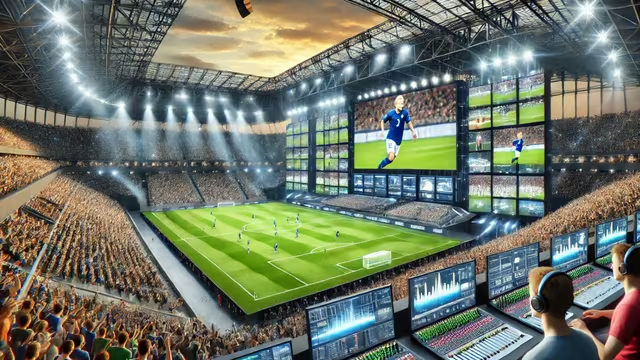
AV Design
Audio Systems - Visual Display Systems - Control & Automation -Specialist Equipment
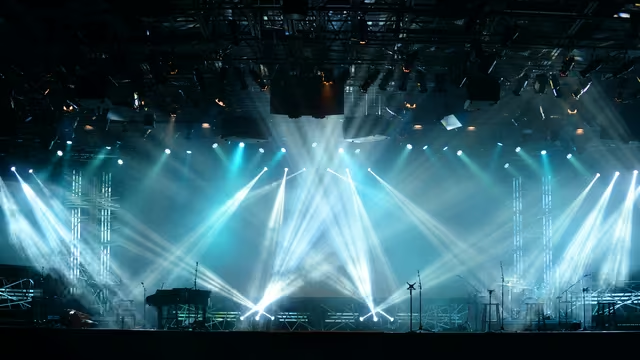
Stage Lighting & Drapery Design
Auditorium stage lighting and drapery have evolved towards automated, energy-efficient, and multi-functional systems that seamlessly integrate with the venue's overall AV framework.
Professional Stage Lighting: Ellipsoidal | Profile Spots LED Par & Wash Lights | Moving Heads | Control Systems
Stage Drapery & Curtains: Grand Drape (Front Curtain) | Legs and Borders | Scrims & Backdrops | Wings
Integration of All Services - Assessment of all services | Acoustic & Sightline Design | Connectivity & Layout | Testing & Commissioning | Training
+build.
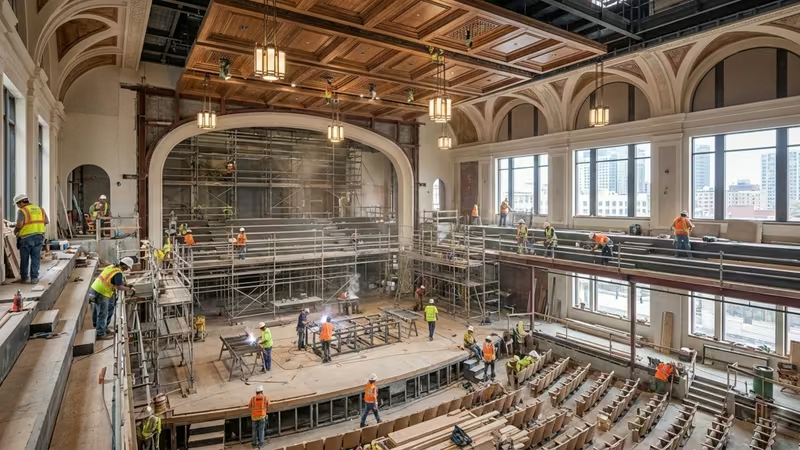
Live Demos
We can organize Demo's at our Dolby Atmos Theatre located at Mumbai where you can experience immersive music. The Experience Centre is also one of its kind in India where in everything that you see is a acoustic solution and is a perfect example of Acoustic Meets Design. On your visit our Team can help you choose the right acoustic products that match your Design element and also deliver great acoustic performance. Over 50+ Solutions can be touch and felt to have a better experience of the product solution.
3D Views & VR Walk Through
Our experienced team curate the best look and feel presentations that bring your space live straight out of your Autodesk keeping in mind acoustic parameters and performance of the space.
Yearly Maintenance Programme
With our own In-house Trained Certified Team of Execution, we have various multiple programmes that can be help the end users to rely on us totally to manage their equipment's.
In-House Team
At Vibrance World we believe in nurturing our own In House Execution Team our team and from years together they have been with us executing projects Pan India. The Team has a strong belief in methodology for construction. Acoustics being specialized cannot be commissioned by layman workers, but our team has learnt over past projects and great experience the true method of delivering projects in time.
Project Tracking System
We have a dedicated team to track the projects and pin the smallest point down to meet timely handover. Acoustic Performance spaces are very complex, as they involve complex layers of material along with tough methodology for applications. This makes it the end user to estimate realistic handovers, therefore our team helps in providing time to time updates to the clients for clarity of progression and to meet deadlines of the assignment.
Seamless Handover
We have seen that in performance spaces the end users are highly entangled and struggling with AV equipment's post handover stage. Our team does in depth product familiarization i.e. the process of training individuals—often operators, technicians on the specific features, functions, limitations, and safety procedures of the equipment's. This not only helps them to DIY but also helps in saving lot of time for problem solving.
Completion Acoustic Test Report
The transition of Sound & Aesthetics from what it was at pre-construction and post handover can be felt naturally. This becomes even better with the help of our high end tools that give figures of achieved performances and it becomes very easy for the end user to compare the results of before and after.
Critical Parameters for Pro Audio & Acoustics
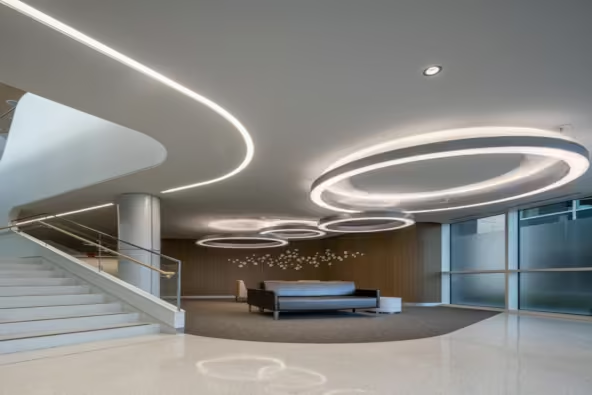
Absorption — The science of RT 60
RT60 (Reverberation Time 60) is the measurement of how long it takes for a sound to “die away” in a room. Specifically, it is the time (in seconds) it takes for a sound to drop by 60 decibels (dB) after the source of the sound has stopped.
Why 60 Decibels?
- 60dB is the standard because it represents the drop from a loud sound (like a shout) to near silence in a typical environment.
- A “Live” Room: High RT60 (e.g., 2.0+ seconds). Think of a cathedral or a tiled bathroom where echoes last a long time.
- A “Dead” Room: Low RT60 (e.g., 0.3 seconds). Think of a recording studio or a bedroom with heavy carpet and curtains where sound stops almost instantly.
The Breakdown
- R (Reverberation): The collection of reflected sounds bouncing around a space.
- T (Time): Measured in seconds.
- 60: The amount of volume decrease (60dB).
Why It Matters
If your RT60 is too high, speech becomes "muddy" and hard to understand because the echoes of the first word overlap with the sound of the second word. If it's too low, the room can feel unnaturally "stifling" or "sucked dry."
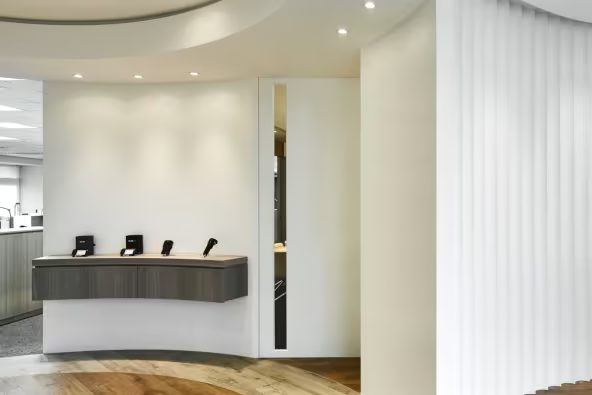
Isolation — Creating a barrier in between layers to block sound
The practice of “soundproofing” a space to prevent noise from traveling between rooms or from the outside. While it is often used as a catch-all term, it specifically refers to blocking or reducing sound transmission through walls, floors, and ceilings.
How It Works
- Acoustic insulation relies on three main principles to stop sound:
- Mass (Blocking): Using heavy, dense materials that are too “lazy” to vibrate, making it difficult for sound waves to push through.
- Absorption (Trapping): Filling the empty gaps inside walls with “spongy” materials to soak up sound energy so it doesn't bounce around like a drum.
- Decoupling (Breaking the Path): Physically separating parts of a wall or floor so vibrations cannot easily travel from one side to the other.
- Sealing (Air-Tightness): Since sound travels through air, isolation requires sealing every tiny gap around doors, windows, and electrical outlets with acoustic sealant.
- Floating Floors: Placing a floor on rubber or spring mounts so that footsteps or machinery vibrations don't travel through the building's frame.
- Acoustic Doors: High performance 4 Side Rebated with Perimeter Seals on Frame as well as Shutters along with Dense Layers in the Shutter.
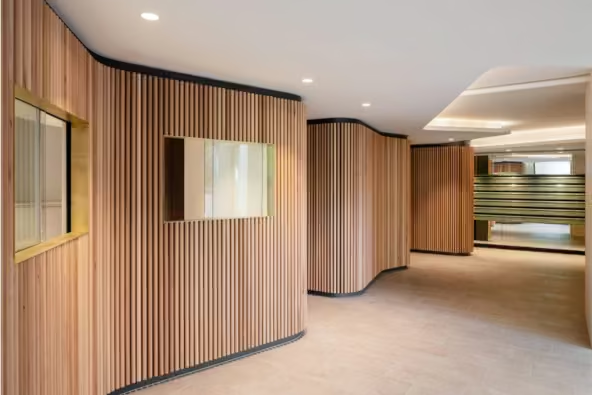
Acoustic Vibration Management
The practice of controlling the physical shaking of objects (structure-borne noise) before it turns into audible sound (airborne noise).
While typical “acoustics” often focuses on sound in the air, vibration management deals with the “silent” energy traveling through solid materials like floors, walls, and machinery. Vibration Isolation (Breaking the Connection): This involves placing a “flexible break” between a vibrating object and its support.
Core Strategies to minimize Vibration & to manage vibrations effectively, three primary methods are used to “interrupt” the path of the energy:
- Using rubber mounts or spring isolators under HVAC unit, or studio speakers.
- “Floating” Systems: Building a Floating Floor or using resilient sound isolation clips to decouple drywall from wall studs.
- Vibration Damping (Soaking up the Energy): Adding materials that convert mechanical vibrations into tiny amounts of heat.
- Materials: Viscoelastic polymers, specialized Rubber Pads, or Specialized Glue between layers of drywall.
Purpose
- To stop metal panels from "ringing" or shared walls from acting like a drum skin.
- Vibration Monitoring (Predictive Maintenance): Using sensors to detect abnormal vibration patterns in machinery before they lead to loud noise or mechanical failure.
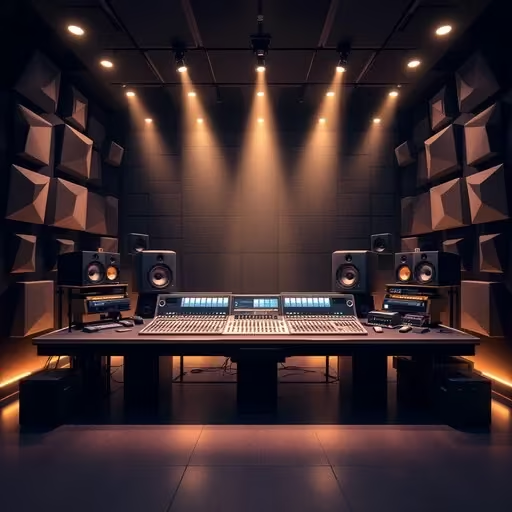
Diffusion
The process of scattering sound waves in many different directions to break up echoes without “killing” the sound of the room.
When a sound wave hits it, the wave gets "chopped up" and sent out at different times and in different directions.
Instead of a flat surface, a diffuser has a bumpy, uneven surface with different depths.
Examples:
- A Mirror (Reflection): A hard, flat wall is like a mirror; it sends a harsh beam of sound straight back at you.
- A Black Hole (Absorption): Foam or thick curtains are like a black hole; they "soak up" the sound so it disappears.
- A Frosted Light Bulb (Diffusion): A diffuser is like a frosted bulb or a disco ball; it takes that one harsh beam and scatters it into a soft, even glow throughout the room.
Why We Use It
- Retains Energy: Unlike absorption (which makes a room feel "dead"), diffusion keeps the room feeling "live" and airy.
- Removes Slap-Back: It gets rid of that annoying "pinging" sound you hear when you clap your hands in an empty hallway.
- Sweet Spot: In home theatres or recording studios, it makes the room feel much larger than it actually is by spreading the sound out evenly.
Technical Brief Definitions
| Common Terms | Treatment | Measurement |
|---|---|---|
| Echo | Absorption | NRC | RT | STI |
| Inaudibility | Diffusion | RT | STI |
| Noise | Insulation | STC | DB |
| Vibration | Vibration Control | STC | Vibration Management | SPL |
| Term | Meaning |
|---|---|
| NRC— | Noise reduction Coefficient The term to measure the absorption value of the product is called NRC. |
| RT— | Reverberation Time It is the time taken by sound energy to die down. |
| STI— | Speech Transmission Index It is a measure of speech intelligibility and quality of the transmission of speech in a certain acoustic environment. |
| STC— | Sound Transmission Class The term to measure the blocking value of the product is called STC. |
| SPL— | Sound Pressure Level The pressure level of a sound, measured in decibels (dB). |
| dB— | Decibel Levels A unit used to measure the intensity of a sound or the power level of an electrical signal by comparing it with a given level. |
| Vibration— | Refers to the wave of sound transmitted by the vibration of the pronunciation of air or characteristic material. |
| Hz— | Hertz is the term to measure frequencies. |